
Off-Screen Space
October 1 - December 4, 2026
In collaboration with the Suraj Israni Center for Cinematic Arts, Off-Screen Space includes experimental narrative films, video art, multi-channel video installations and a cinematic performance–all made by artists who reside or created the work on the west coast and in the region. The works in the show exist across every surface of the gallery and expand the experience and expectations of the ‘screen'.
Participating Artists:
Ava Aviva Avnisan, Dana Berman Duff, Zachary Epcar, Victoria Fu, Lev Kalman with Whitney Horn, Omar Lopex, Sarah Rara, Christopher Richmond & Young Joon Kwak, Rajee Samarasinghe, Lorna Simpson, Josh Tonies, Kerry Tribe, Adriana Trujillo, Jennifer West, Zomhlaba
Curated by Alison O’Daniel
Curatorial Assistant: Evan Apodaca
Image: Kerry Tribe, "Near Miss," 2005. Video projection with sound. Production still.
Full Exhibition Description
In collaboration with the Suraj Israni Center for Cinematic Arts, Off-Screen Space includes experimental narrative films, video art, multi-channel video installations and a cinematic performance - all made by artists who reside or created the work on the west coast and in the region. The works in the show exist across every surface of the gallery and expand the experience and expectations of the ‘screen'.
“Off-screen space” is a term used primarily in cinema that refers to a sensation that the image, sound, action and ideas can move past the edges of the screen. The off-screen space is possibly the most profound and magical space of cinema, because whether it is produced through the technical smoke and mirrors of cinematic production (such as editing or surround sound) or narrative construction (a subject looks beyond the frame and the audience anticipates what might appear), it is also the undefined amorphous place where our human spectator bodies are touched by physical sound waves, light and shadow, and the affect and lasting impact of the moving image. The off-screen space in cinema is where the suspension of disbelief occurs most poetically during the film. Even after the credits roll, off-screen space continues; it is where ideas, narrative, locations, characters and actions hover like ghosts, further develop, take on new meaning and shapeshift.
In this exhibition, the artworks expand these ideas further off-screen. The screen is simultaneously the object, the suggestion and the idea. Embodied multi-channel installations fragment time and narrative and challenge the eye, mind and body to comprehend a multiplicity of occurrences happening across several screens at once. Some of the pieces pull back the cinematic curtain or break the fourth wall to reveal the richness and complexity and equal importance of relationships between director, subject, crew, audience and even studio and sound stage - sites usually hidden and unseen. Several of the works fragment and disorient our bodies as the image and its physicality tricks, breaks down or fights against the container of the screen.
Off-screen space can also refer to the gallery, the museum, the experimental or black box theater - spaces that exist away from the historic, psychoanalytic projections and social contracts of desire and ownership that have so long flooded the construction and framing of images and bodies on the screens and in theaters of the film industry. Many of the films and videos in this show question the projection and framing of memory, desire, and history. These works propose new models of not only cinematic production and exhibition, but also cinematic seeing, listening and believing and engender modes of participation and engagement that are rooted in the history of experimental film. Further, in this contemporary moment in which screens dominate our existence and everyday lives, some of these works paradoxically question the ubiquity of screens and their impact on global life, our well-being and the climate, and propose a shift off-screen and back into real life.
Finally, a brand new commission by Victoria Fu, Colorways, is a ticker installed on the transparent exterior LED mesh screen that wraps around three sides of the building. The text moves with and against the flow of passersby, words floating against sky and structure. More than two hundred color names appropriated from commercial paint, cosmetics and automotive catalogues, scroll across and around the screens, each phrase rendered in the color it claims to describe. Read in sequence they become a found poem in spectral order, a record of an industry trying to approximate and trademark hue in words; as a 40-minute, infinitely looping parade of words on LED signage, the approximations point to the failure of language to hold color.
On the Mediamesh Facade
Victoria Fu
Colorways, 2026
Video, silent, 40-min loop
GKD Mediamesh facade, Mandeville Art Gallery, UC San Diego
The 203 color names in this work are quoted verbatim from the product catalogues of the manufacturers listed below. No name has been invented, abbreviated, or otherwise altered.
Architectural and interior paint: Backdrop, Behr, Benjamin Moore, Clare, COAT, Color Guild, Dunn-Edwards, Dutch Boy, Farrow & Ball, Glidden, Graham & Brown, Little Greene, Magnolia Home, Martha Stewart, Paint & Paper Library, Sears, Sherwin-Williams, Tint Paint, Valspar
Cosmetics: Anastasia Beverly Hills, Black Moon, Bobbi Brown, Chanel, Charlotte Tilbury, Chillhouse, ColourPop, Danessa Myricks Beauty, Dior, Half Magic, Il Makiage, Illamasqua, KVD Beauty, MAC, MAKE UP FOR EVER, Maybelline, Medusa's Makeup, Melt, Morphe, Sydney Grace, Tarte Cosmetics, Tom Ford, Urban Decay
Nail lacquer: Cirque Colors, Clionadh, Death Valley Nails, DND Gel, Essie, ILNP, Mooncat, OPI, Poparazzi, Sally Hansen, Swamp Gloss
Automotive: Ford, General Motors, Mopar, Pontiac, TVR
Color systems: Pantone
All names are the trademarks or product designations of their respective owners, reproduced here as found language. Their use in this work is neither endorsed by nor affiliated with those owners.
About Cinematic Arts
UC San Diego’s new Cinematic Arts and Film Studies major and the Suraj Israni Center for Cinematic Arts enables students to consider new models of cinematic production and thinking. Drawing on the decades-long rich history of interdisciplinary and critical approaches to media, moving image, and experimental video practices in the Department of Visual Arts at UC San Diego and across the university, this show emphasizes that the term ‘cinematic arts’ is expansive, inclusive, global, and evolving.
Gallery Tours
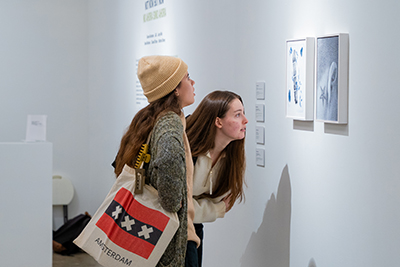
The Mandeville Art Gallery offers free 60 minute exhibition tours led by our Gallery Guides for both groups and individuals.
Gallery Guides are always available at our Welcome Desk to answer questions.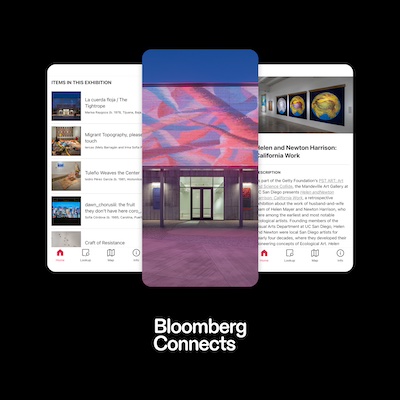
Free Digital Guide
Explore our free digital guide on Bloomberg Connects—the arts and culture app that lets you dive deeper into exhibitions, museums, and cultural institutions. Enrich your visit with exclusive content, enhanced accessibility, audio guides, exhibition maps, and artist talks—all at your fingertips.